

Free Post - Half-Time

What TSF Is:
A comprehensive swingtrading resource that saves you time, analyzes the market and searches for interesting opportunities and setups in stocks
A trading educational resource that is aimed to help you build a methodology, process and risk management & execution framework to be able to trade according to good trading principles
A community with a private Discord
TSF - Analytics platform
What TSF Is Not:
A trade alert service. I share all of my own trades, but those are my own personal trades and thoughts that I journal. They are never a recommendation to buy or sell anything, nor any type of financial advice
Nor are the setups a recommendation to buy or sell anything, nor any type of financial advice. Every setup needs to trigger to become valid, I only share my own views on the setups and the stocks I talk about.
The Market Is Chopping Around
Trapping us and shaking us out at the same time, tough tape. That is what a rangebound market does, and that is why it is important to sometimes take a deep breath and a couple of steps back.
Because we are at the half-time mark. Half the year is done, and it has been a wild ride so far.
And instead of looking at stocks today, I would like to use this last trading day and shortened week to zoom out and focus on the time ahead.
Gains Are Not Evenly Distributed During The Year
And this is a key insight, one that protects me and keeps me leveled headed. Most gains are made in a short amount of time, and the rest is just risk management and staying in the game without bleeding, until things improve again.
And what decides if we make gains or not is not our entry tactics, our strategies, those are details we tweak.
What matters is the market conditions.
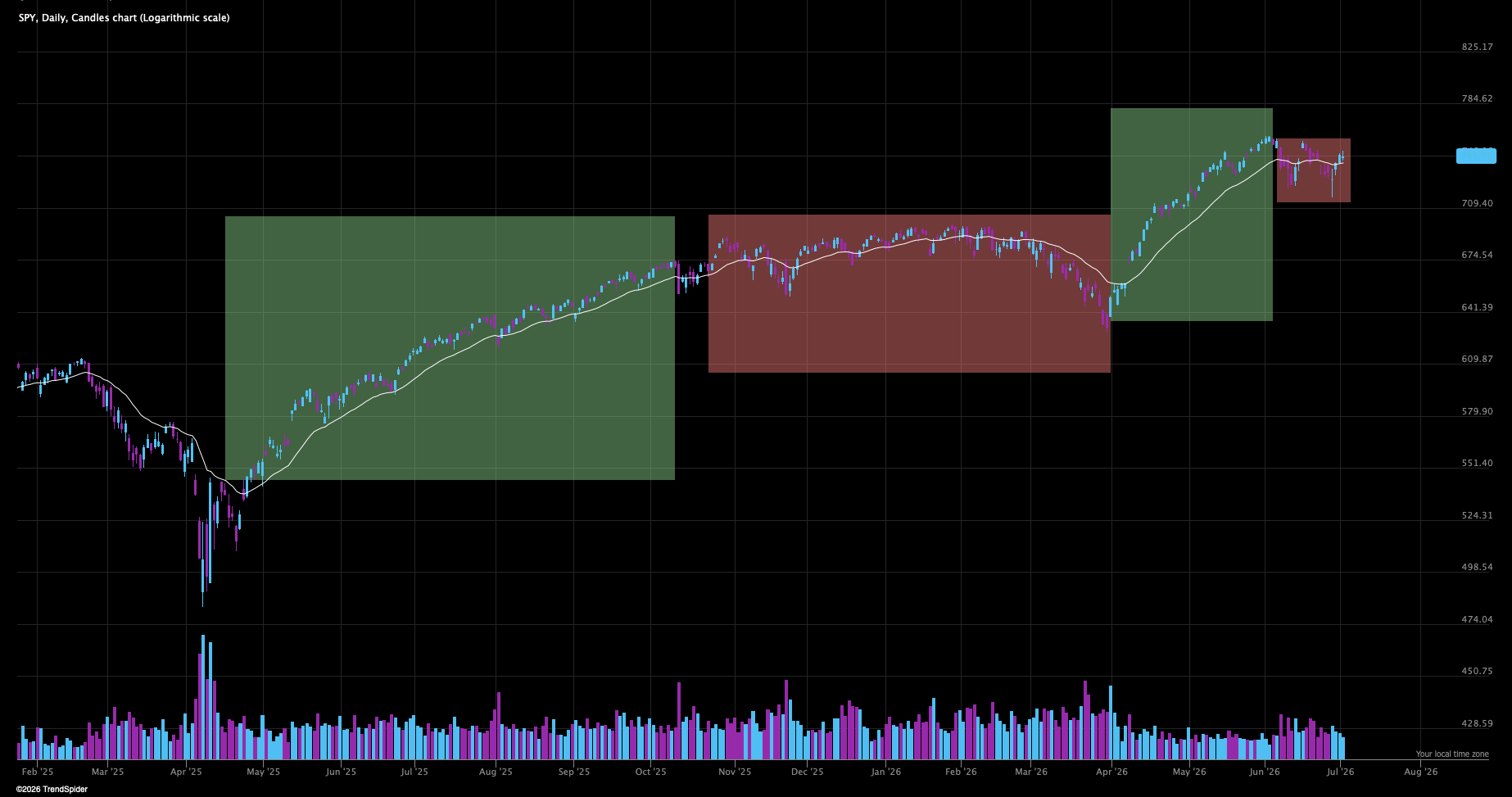
You can plot your equity curve on this, if you are trading growth stocks and trail stocks, your equity curve is index with leverage.
Looking at a large cap leader like AMD, you see this clearly.
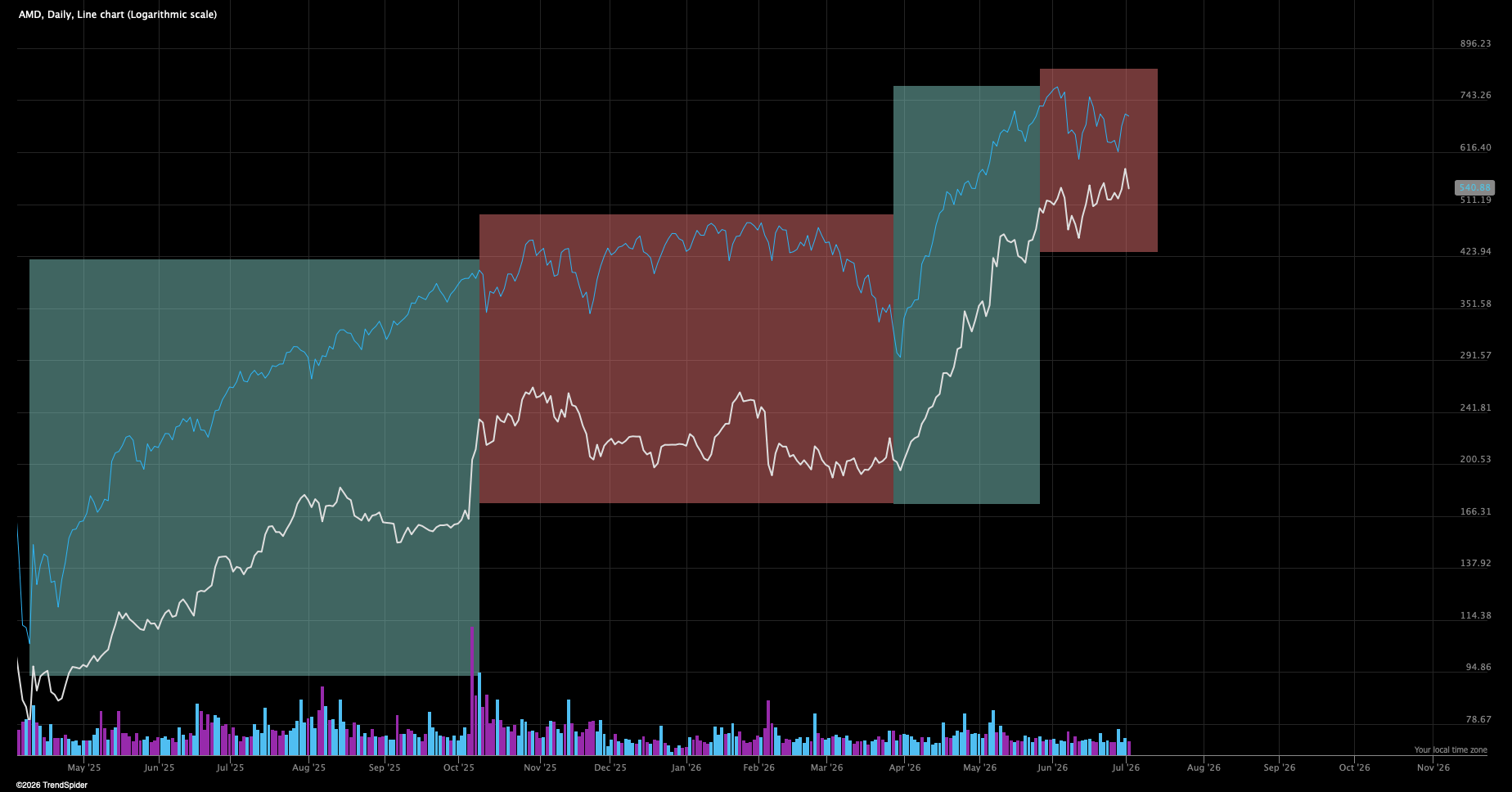
Index with leverage.
At the same time the best opportunities arise from relative strength coming out of a correction, leaders being born.
And it sounds easy, to buy the strongest stocks breaking out when the market turns.
The tricky part is in a rangebound market, the market can turn over and over and over again. And the leaders will try to break out and fail, over and over and over again.
And when they finally make their real move, we are too hurt to participate.
So if we know that we should only participate when the market is conducive for our strategy, why do we continue pushing it at the worst time?
Greed, forcing our hopes and dreams upon the market, lack of mental clarity and objective analysis.
This affects all, everyone, even the most experienced traders. What changes over time is that the windows of sloppy trading and overtrading become briefer, risk gets tighter over time and thus the drawdown. But I have no high horse to sit on, I still put on some unnecessary new trades recently despite the gut feeling me not to.
It is part of trading, internal honesty is what lets us improve over time — and not punishing ourselves for doing things that end up being wrong. Without confidence we can’t trade — so beating ourselves up defeats the very goal we are trying to achieve. The way is to re-focus — sharpen up, your next trade is what matters.
Because here is the thing, you also need to put on unnecessary trades from time to time — this is probing the market, sensing it if the it is about to improve and turn or not. And that’s where progressive exposure and bet size comes into play.
What people do wrong is adding too much risk too quick, this is what produces the drawdowns, not the 0.3% equity risk on a new trade, even if you do that 10 times it’s a 3% haircut only.
But since we are humans and like to be right, we see this incredible breakout in a new market leader — so we size up.
That behavior is punished more often than not, there is nothing wrong with a small starter, and if I am are right and the stock continues up — I can add.
Cushioning my downside risk, thanks to the first trade when I add.
The Second Layer — Trails
But there is a second layer, even if I cap my current new exposure, and continue to be firm with your risk management — if I have stocks deep in the money, even up 100%+ like MU for me, when those decline, they will work together with my new exposure to cause you pain.
And trailing stocks is not for everyone, it is both a blessing and a curse. Trailing stocks ensures you are not at your equity highs for long, because trail will pull back in natural pullbacks for the market.
But trails exponentially adds potential to the overall performance, since I can capture outsized moves. Again not for everyone, some people like to go in quick and exit quick, some like to linger like me — do what works for you.
But it is important to understand the cost of trailing stocks, because exponential potential must cost something.
And the cost is a nice give back when the trend ends. That is why I always sell into strength, because when you sell into strength you are selling at the highs of that trade — it helps me withstand natural pullbacks in stocks.
The Third Layer — Selling Into Strength And Doing Crappy Trades After
The function of selling into strength is to protect my equity when an extended stock then naturally reverses.
If I then put that hard earned capital in B- setups — that defeats the purpose. A mistake I made recently, however I made it with very little risk which is good. But the size doesnt matter, what matters is the mentality and the framework.
A Product Of Good Gains
And this is something I really have worked on, but something I need to work on everyday for the rest of the year.
I have had a great run when I look at where I stand at half-time, I’m on track of what I am aiming for, but after a great run — pain usually follows.
And when we have a great run we feel smart, we feel confident, we feel good. This dopamine kick is our enemy — because it is easy to start becoming sloppy, overtrade and put too much weight on your own analysis.
I am not a genius for making good gains when the market has run up hard — that is the market not me, my part is just participating heavy when I notice things working.
The real test comes now, when things become tricky and how we handle choppy conditions and a tough tape.
Those That Make The Most Drawdown The Hardest From Equity Highs— If You Trail Stocks
And this is also a key insight also highlighted by Qullamaggie, because if you participate in the stocks that make outsized moves, sell into strength, do everything according to the book.
When those stocks start stalling, and they always stall together — the door is too narrow for the crowd, and they reverse hard.
Does that cancel out all gains made over the last couple of months? No. I focus on the process and the progress over time.
Equity highs tells us nothing, because we don’t live there for long if you trail stocks — the money belongs to the market until you pull it out.
What I do care about however, is if my equity curve is doing higher lows, and I really recommend equity curve analysis.
If the equity curve us doing higher lows, things are going well. Downside is protected, progress is made over time.
This is what I watch the most personally and if the equity curve is doing lower lows that is a full stop red flag for me that would likely put me in cash completely and reset my process.
And don’t forget that you only need 5.5% monthly compounded returns to make a triple digit year.
Process >outcome will lead to good outcome.

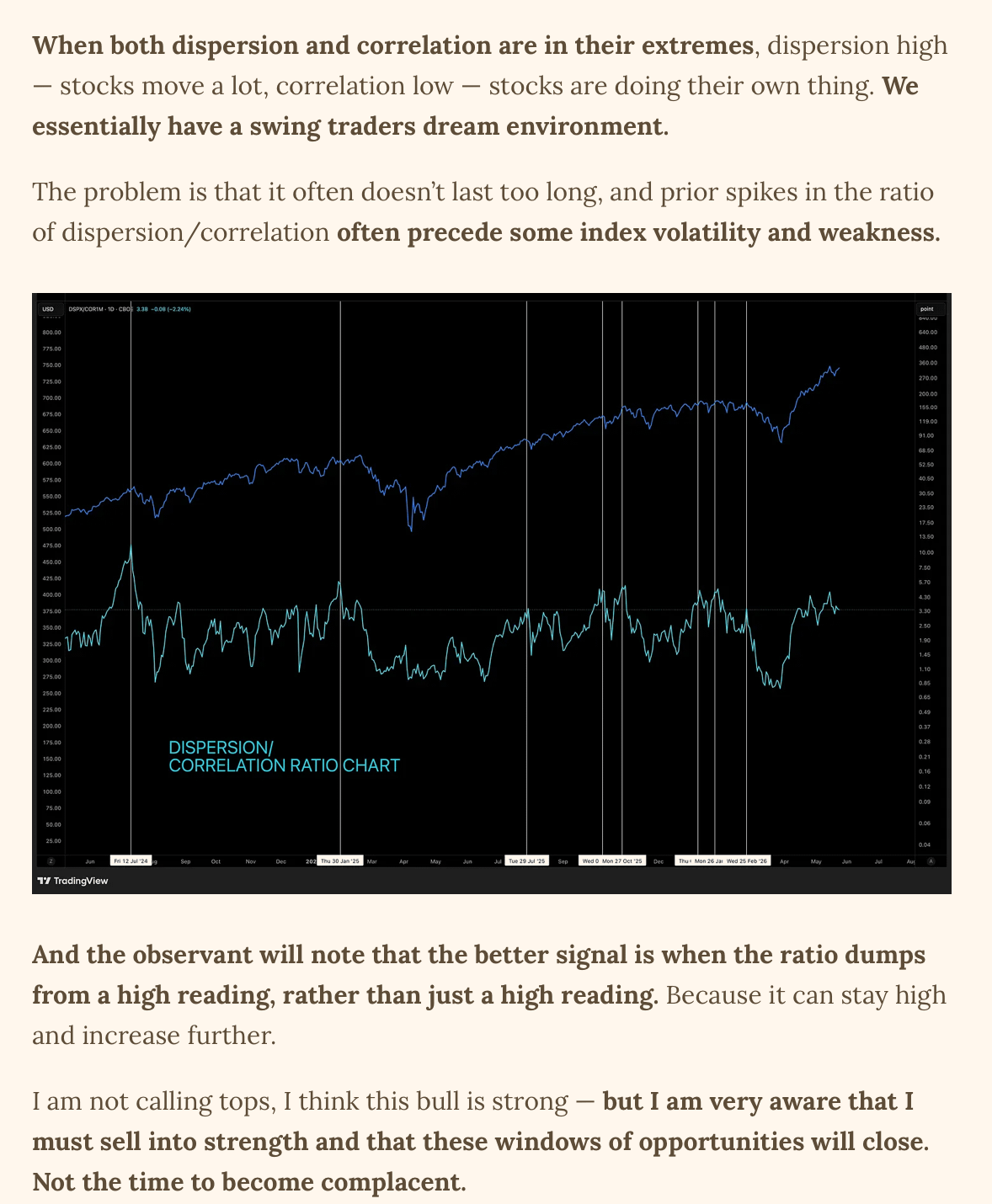
We Feel Smart Because Correlation Has Been Extremely Low And Dispersion High
This essentially means:
Correlation: Stocks don’t move together, they move on their own merit — stock picking
Dispersion: There is a large performance gap between winners and losers
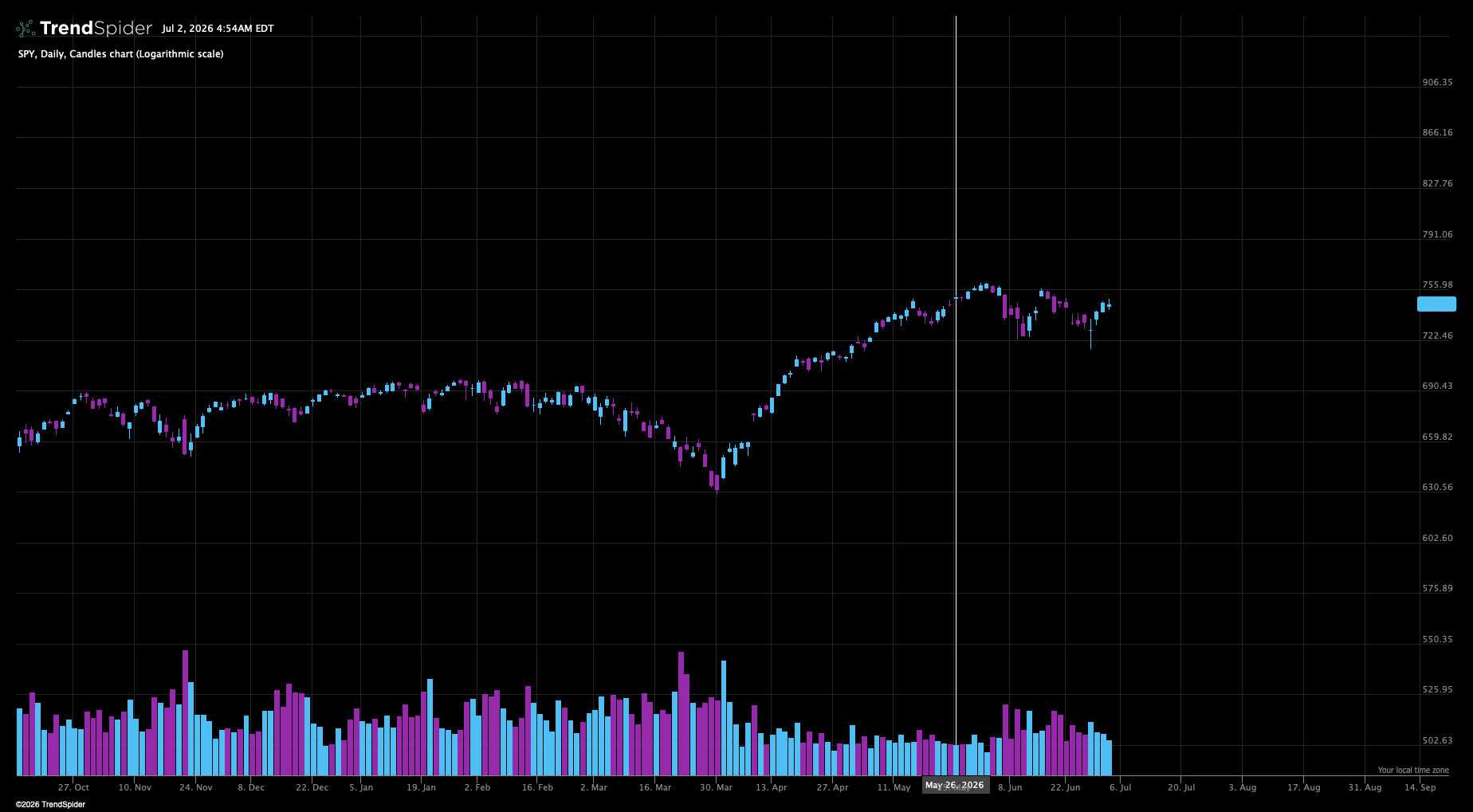
A stock pickers paradise. The problem is that, doesnt last long. This is from May 24 our analysis called “Dispersion & Correlation”.
Lets start with plotting that date on the chart, it’s a Sunday so here we see the next day.
So Where Are We Now?
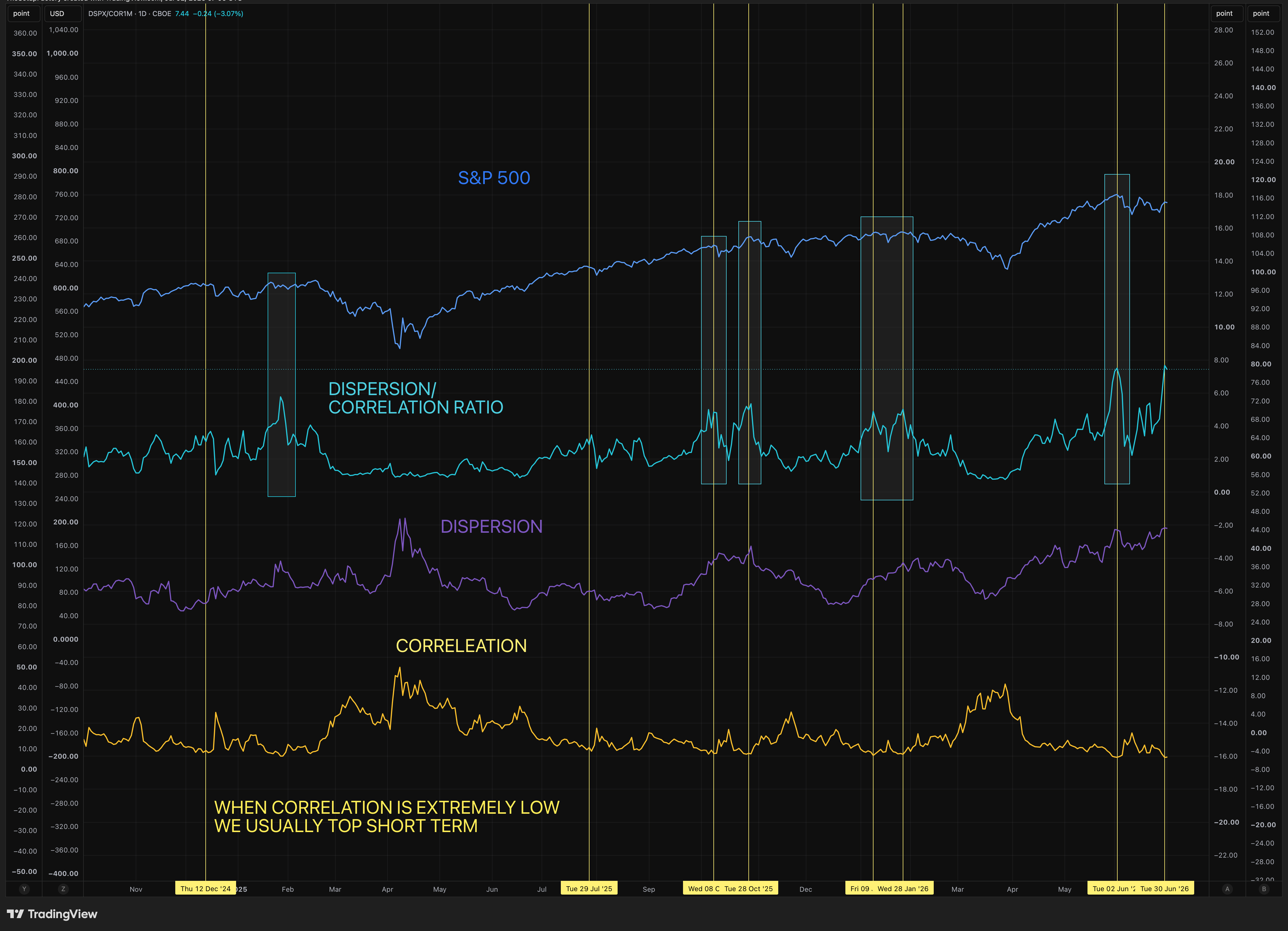
Still a swing traders dream environment, but we might not be feeling it because capital has moved elsewhere and rotated out of what lead the advance up to now.
And just like in the market analysis, this is not sustainable, correlation will snap back soon, and dispersion will fall soon.
And that will likely be followed with a swift decline. It doesn’t mean the end of the bull market, but this feels like a delicate spot.
But just like in May, I think I am a little early, madness can always continue some more.
But this is here, and this is important. Extreme low correlation environments can be dangerous, because when things normalize everything moves together again.
Maybe they will move higher together instead of lower, I am just highlighting a potential inflection point approaching.
And elevated volatility and inflection points can be delicate spots where outsized moves both ways can occur.
The Implications Of KOSPI
Everyone are focused on KOSPI, and KOSPI matters. We are essentially seeing liquidity coming out of the system.
And massive leverage together with tightening liquidity is not a good mix of things.
And I was afraid KOSPI would ruin the fun heading into this week.
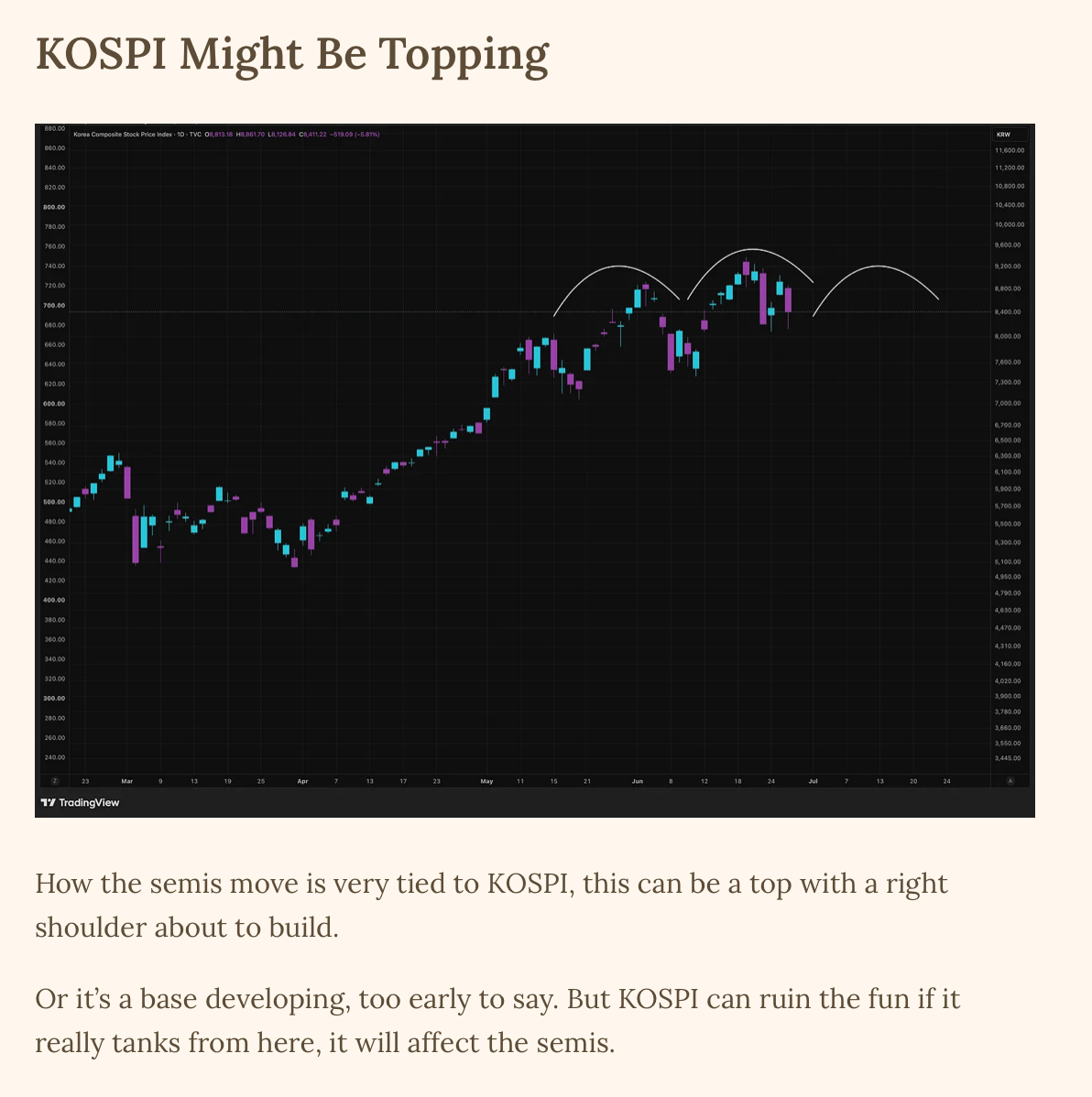
What is more interesting is the relationship between KOSPI, S&P 500, bitcoin and gold.
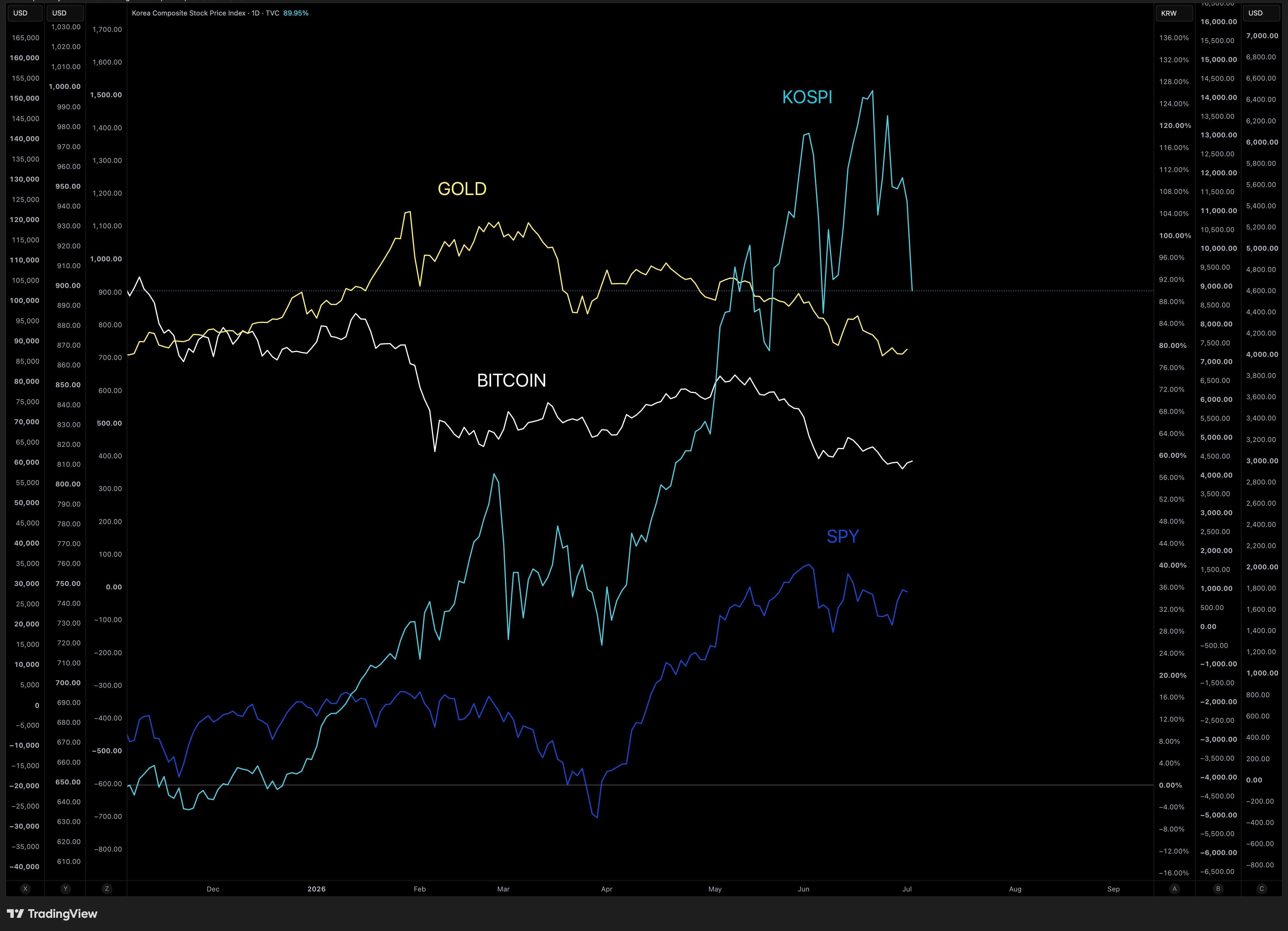
You might not have noticed but gold and bitcoin moves the same when looking at the bigger picture lately, I have interpreted it as a sign of liquidity and risk assets moving together, and KOSPI moved with them as well.
But when the AI trade really took off, both bitcoin and gold were sold and capital flowed into the AI-trade — and KOSPI and S&P 500 now moves together.
Liquidity is moving from risk asset to risk asset, it’s the same money flowing.
When semis weaken, bitcoin strengthens — we can see it in TSF - Analytics as well.
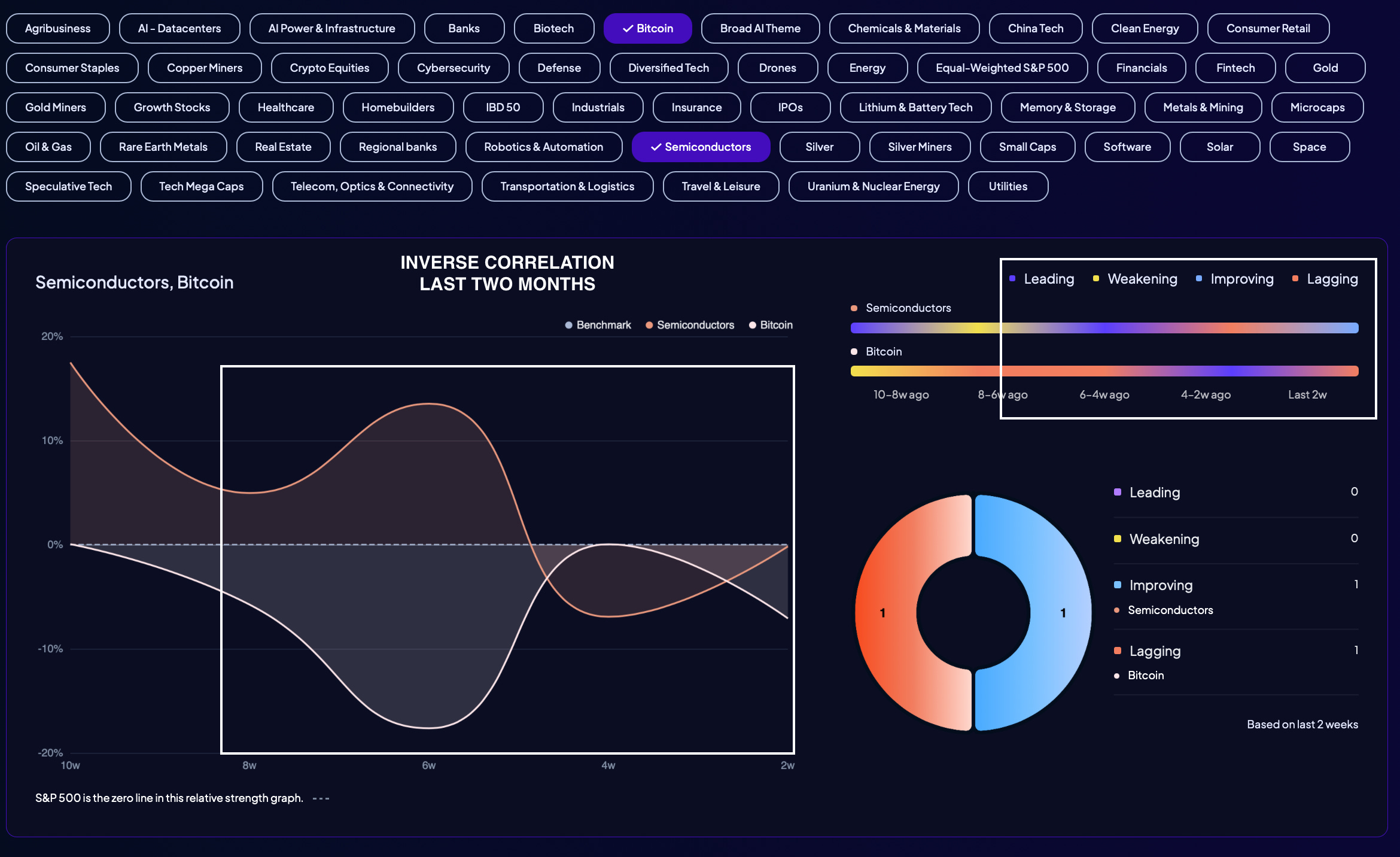
And this is new, and a dynamic that has built during the last two months.
So what does it mean? I am unsure, but but big things are in motion under the hood if the KOSPI bubble really cracks here — I am not sure it will yet personally.
I think we can expect risk capital being put to work aggressively elsewhere.
But currently, liquidity is tightening short-term, which always puts pressure on the capital deployed farthest out the risk curve — like KOSPI.
We Rarely Top When People Expect It
Which is the beauty of being a trendfollower — I just manage risk, deploy capital when the market is telling me to — and get out when it signals danger.
No predicting needed — just reaction. And personally I feel we need to chop around more before something excessively ugly occurs, but I remain open minded.
And looking at where the pain trade is in stuff like MU — it likely is chop and wild swings before the fun ends.
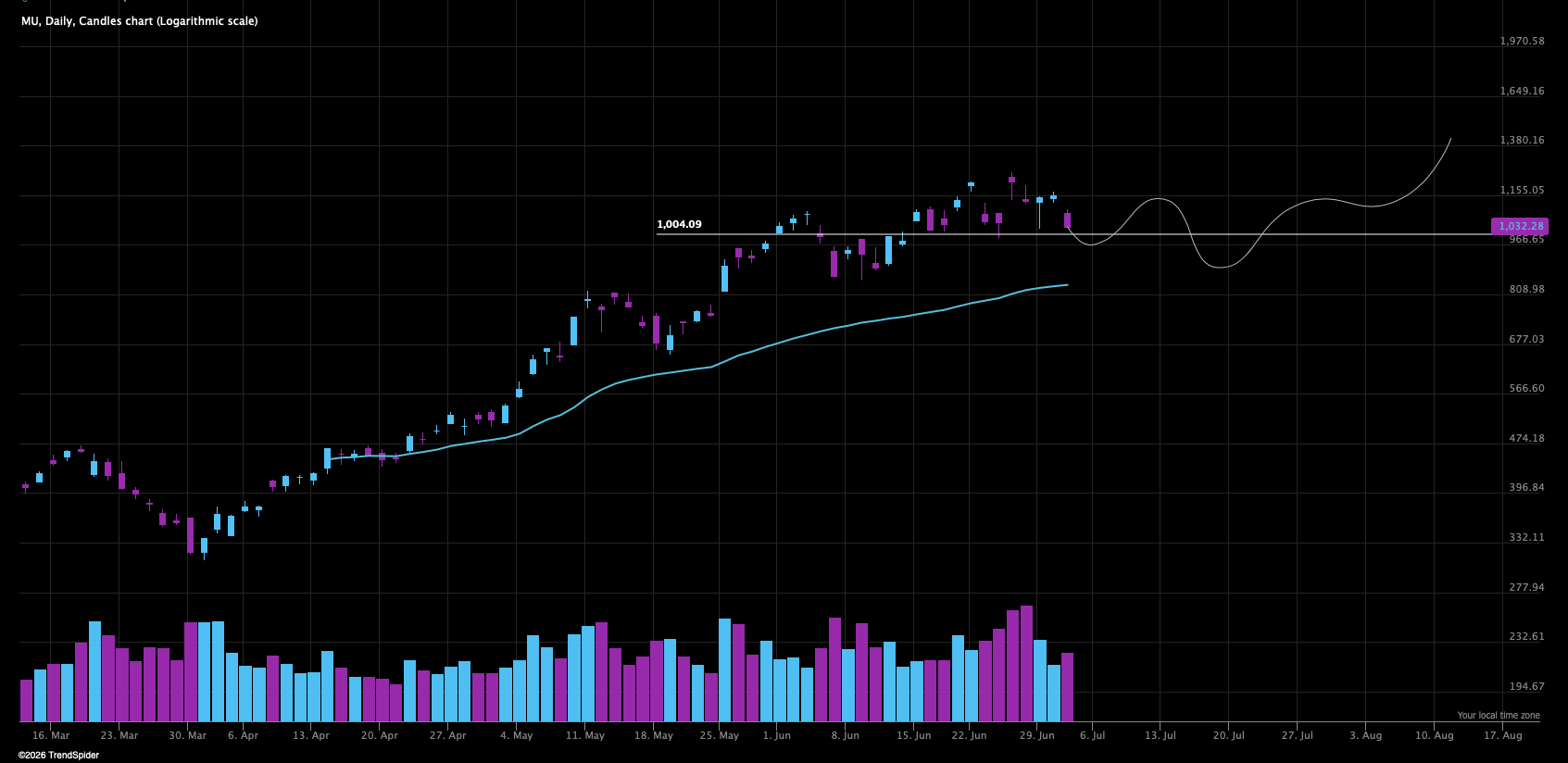
We have the 1k level that is significant, a level like that is usually undercut to sweep up liquidity.
And leaders like MU likes to re-visit highs or put in a new ATH sucking in more of retail before really topping. Because if it is a top, institutions likely need to let it bounce to distribute stocks.
But until we really fail and loose the committed buyers that broke us out — this is a new base forming until proven otherwise.
Either way I don’t care about the fundamentals, how great the earnings are — I don’t get married to stocks.
Every great stock in history tops inevitably, and I am not there when it crashes.
Half-Time Is A Time For Re-assessment
Incredible returns can be made in half a year — half a year is a long time. Now is the time to re-assess, look at what’s working, what’s not working — what can improve. Enforcing what is going well, and working on what is going wrong.
Internal honesty is essential for anyone looking to improve.
And I want to end with a key insight. Lost money is not made back from the same stocks or the same poor strategy.
Lost money is lost.
New money is gained by working hard on improving.
Wish you a nice day,
Jonas
Charts courtesy of TradingView
Charts courtesy of TrendSpider
Disclaimer:The Setup Factory and The Setup Factory Analytics are not registered investment advisors, broker-dealers, or financial planners, and are not licensed to provide investment, legal, or tax advice in any jurisdiction. All content provided through The Setup Factory Substack publication, The Setup Factory Analytics platform, and any associated communications reflects personal opinions, observations, or analytical interpretations and is provided for educational and informational purposes only.
Nothing contained herein should be construed as investment advice, a recommendation, solicitation, or offer to buy or sell any securities, financial instruments, or assets. Any analysis, data, tools, indicators, dashboards, or models provided by The Setup Factory Analytics are intended solely to support independent research and decision-making and do not constitute personalized investment advice.
Investing and trading in financial markets involves substantial risk, including the possible loss of some or all of your invested capital. Past performance is not indicative of future results. You are solely responsible for your investment decisions and for evaluating the merits and risks associated with any investment.
You should conduct your own independent research and due diligence and consult with a qualified, licensed financial advisor or other professional before making any investment decisions. By accessing or using this content or platform, you acknowledge and agree that The Setup Factory and The Setup Factory Analytics shall not be held liable for any losses, damages, or decisions arising directly or indirectly from the use of the information provided